26, 27.5 or 29 inch: which mountain bike wheel to pick
Under about 170 cm of height, a 27.5-inch wheel is usually the better fit; above that, the 29-inch wheel is the norm, and it rolls over rough ground more easily. The 27.5 accelerates and turns more quickly, and the 26 is the oldest and smallest of the three.
What 26, 27.5 and 29 inch really measure
The inch names do not describe one thing. Sheldon Brown's tyre sizing article lists the ISO bead seat diameter, the diameter of the rim where the tyre sits, for each name: 559 mm for the 26-inch mountain bike size, 584 mm for the size sold as 27.5 (also called 650B), and 622 mm for the 29-inch size, which is the same rim as a 700C road wheel. Schwalbe says that 29 inches is named after the outer diameter of mountain bike tyres, and that its 28 and 29 inch sizes share a 622 mm inner diameter. It also warns that inch labels are imprecise: 559, 571 and 590 mm are all labelled 26 inches.
| Name | Bead seat diameter | Also called | Difference from 26" |
|---|---|---|---|
| 26" | 559 mm | 26 inch MTB | 0 mm |
| 27.5" | 584 mm | 650B | 25 mm |
| 29" | 622 mm | 29er, 700C | 63 mm |
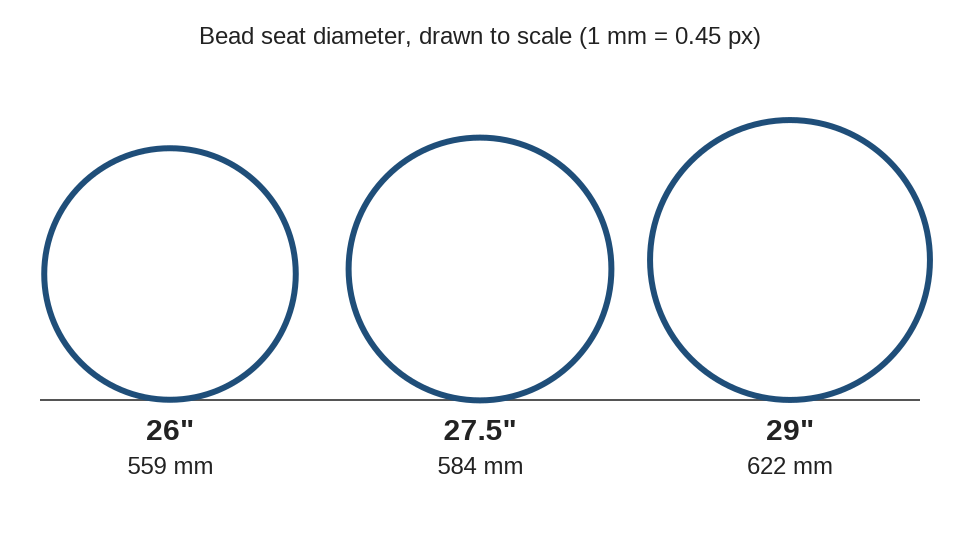
With the same tyre on each rim, the outer diameter grows by the same amount as the rim. Going from 584 to 622 mm adds 38 mm, so the wheel's circumference grows by 38 × π, about 119 mm, on every turn. From 559 to 622 mm it is 63 × π, about 198 mm.
The tyre that fits is the one whose ETRTO label ends in the same number: a label ending in 584 goes on a 27.5-inch rim, one ending in 622 on a 29-inch rim. The tyre size reader turns any label into its bead seat diameter.
Roll-over and acceleration
Two makers explain the trade-off, and they agree.
Giant gives figures, measured against a 26-inch wheel and without a date on the page: a 29-inch wheel rolls over a 6 cm square-edged obstacle 14 % more efficiently, a 27.5-inch wheel 9.8 % more. On acceleration it says a 27.5-inch wheel is 1.5 % slower than the 26-inch one and a 29-inch wheel 3.6 % slower, because the weight sits farther from the hub. Giant's own reading is that the 27.5 comes close to the 29 on roll-over without the weight penalty (Giant).
Canyon, in a page updated on 17 October 2025, puts it in words: 29-inch wheels clear larger obstacles and lose less speed on rough trail, and they are heavier, so they are slower to get up to speed and need more effort to change direction. A 27.5-inch wheel is quicker to accelerate and turn but holds less momentum, and is more likely to hang up on an obstacle (Canyon).
| 26" | 27.5" | 29" | |
|---|---|---|---|
| Roll-over of a 6 cm edge, against 26" | reference | 9.8 % better | 14 % better |
| Acceleration, against 26" | reference | 1.5 % slower | 3.6 % slower |
| Canyon's summary | not covered | quicker to turn, less momentum | holds speed, heavier |
Opinion, marked as one: for cross-country and long rides on rough ground the roll-over counts for more than the extra weight, which is also Canyon's advice (full 29-inch wheels for cross-country). On tight, twisty trails the quicker handling of the 27.5 can be worth more.
Which size fits your height
Wheel size is not the only thing the frame size decides. The bigger the wheel, the harder it is to fit it to a small frame. Giant notes that small 29-inch frames run into geometry limits.
In the Cube table published by the retailer Lucky Bike, 27.5-inch wheels go up to 167 cm of body height and 29-inch wheels start at 168 cm. The full table, size by size, is in the Cube size chart post.
Canyon draws a similar line from a different side. Riders under about 170 cm may find a 29-inch rear wheel touches them when they slide back off the saddle on a steep descent, and a 27.5-inch rear wheel gives more clearance. Its XS and 2XS sizes of the Grand Canyon and Neuron have 27.5-inch wheels at both ends, and its Spectral XS takes a 27.5-inch rear wheel only.
Worked example: three riders
165 cm: the Cube line puts this rider on 27.5-inch wheels. Canyon's 170 cm mark points the same way.
169 cm: the Cube line gives 29-inch wheels, but 169 cm is under Canyon's 170 cm. Sit on both if you can, and check the clearance behind the saddle.
178 cm: 29-inch wheels, well clear of both the Cube line at 168 cm and Canyon's 170 cm.
Sizes between brands differ, and the frame size has its own rule: see why one brand's M is not another's and the bike size calculator for the frame.
What about 26 inch and the mixed setup
A 26-inch rim is 559 mm. Canyon's page says nearly all mountain bikes had 26-inch wheels about twenty years ago and says nothing about the size today, and the Cube line described above has no 26-inch size. If you own a 26-inch bike, tyres with a 559 mm bead seat are still the ones that fit it.
Canyon also describes a mixed setup, called a mullet, with a 29-inch front and a 27.5-inch rear. It says the setup is most popular in technical disciplines such as downhill, and that 27.5 is now mainly used as a rear wheel there. You get the roll-over of the big front wheel and the rear clearance of the small one.
Questions
Can I put 29-inch wheels on a 27.5-inch frame?
The tyre is not the obstacle: a 622 mm rim takes a 622 mm tyre and nothing else. What none of the sources above cover is clearance in the frame and fork, so ask the maker of that frame.
Is 27.5 the same as 650B?
According to Sheldon Brown, yes: 584 mm is the 27.5 size, and the 650B of the French system. Sheldon Brown also lists 650B on French utility bikes, tandems and touring bikes, so check the millimetre number on the label rather than the name.
Where the figures come from
- Sheldon Brown and John Allen, Tire Sizing Systems (ISO/ETRTO bead seat diameters)
- Schwalbe, tyre sizes: how ETRTO, inch and French labels are written
- Giant, 27.5 Technology (acceleration and roll-over figures against a 26-inch wheel)
- Canyon, 27.5 vs 29-inch mountain bike: which wheel size should you choose? (updated 17 October 2025)
- Lucky Bike, Rahmenberechnung (a Cube table with the wheel size per frame size)
Published by Cursa de duminică (Tanna Software S.R.L). About the site, Methodology and sources.