How long is a lap in lane 8
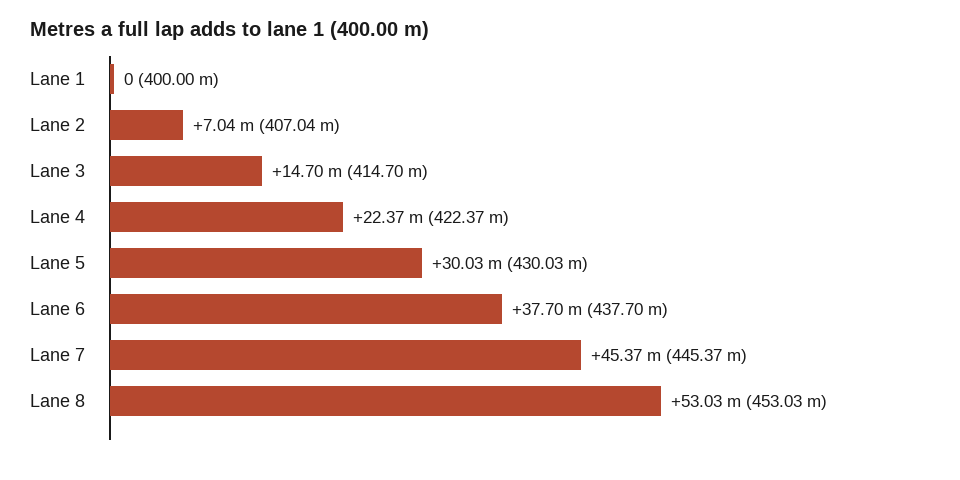
One lap of lane 8 on a standard 400 m track is 453.03 m, which is 53.03 m more than a lap of lane 1. Every lane to the outside has a wider bend, so it is longer, and the straights are the same for all eight.
Why the lanes are different lengths
A standard track is two straights joined by two half-circle bends. The World Athletics Track and Field Facilities Manual (2019 edition, page 30) gives the straights as 84.390 m each and the bends as half circles with a radius of 36.500 m at the raised kerb. Lanes are laid side by side, so a lane further out runs round a circle with a larger radius. The straights do not change.
Lane 1 is measured on a line 0.30 m outside the kerb, a radius of 36.80 m. The manual's Figure 2.2.1.1b (page 31) shows that the other lanes are measured differently: lane 2's running line, at 37.92 m, is 0.20 m outside the lane marking that bounds it on the inside, whose outer edge is at 37.72 m.
The lap length of each lane
The manual works out lane 1 on page 31: two straights of 84.3900 m make 168.7800 m, and two bends of 36.80 m × π, 115.6106 m each, make 231.2212 m. The total is 400.0012 m.
For the other lanes the same sum applies with a larger radius. All lanes are 1.22 m wide, including the 0.05 m line on the outside (page 30), so the radius of lane n is 36.50 + 1.22 × (n − 1) + 0.20 m. That is the site's extension of the manual's lane 2 figure to the lanes beyond it; the manual prints a running-line radius only for lanes 1 and 2.
| Lane | Radius of running line (m) | Bends, 2 × π × r (m) | Lap (m) | Added to lane 1 (m) |
|---|---|---|---|---|
| 1 | 36.80 | 231.22 | 400.00 | 0 |
| 2 | 37.92 | 238.26 | 407.04 | 7.04 |
| 3 | 39.14 | 245.92 | 414.70 | 14.70 |
| 4 | 40.36 | 253.59 | 422.37 | 22.37 |
| 5 | 41.58 | 261.25 | 430.03 | 30.03 |
| 6 | 42.80 | 268.92 | 437.70 | 37.70 |
| 7 | 44.02 | 276.59 | 445.37 | 45.37 |
| 8 | 45.24 | 284.25 | 453.03 | 53.03 |
Lane 1 to lane 2 adds 7.04 m, not 7.67 m, because lane 1 is measured 0.30 m from the kerb and the others 0.20 m from a line. From lane 2 on, each step adds 1.22 m × 2π, 7.67 m.
Worked example: lane 8
Radius of lane 8: 36.50 m (kerb) + 7 × 1.22 m (seven lanes inside it) + 0.20 m = 45.24 m.
Two bends: 2 × π × 45.24 = 284.25 m.
Add the straights: 284.25 + 168.78 = 453.03 m.
Compare with lane 1: 453.03 − 400.00 = 53.03 m, and 53.03 ÷ 400.00 is 13.3 %.
At the same speed the lap takes 13.3 % longer. At 5:00 per km, which is 0.3 s per metre, lane 1 takes 120.0 s and lane 8 takes 453.03 × 0.3 = 135.9 s, so 15.9 s more for one lap.
Why the pace drawing uses lane 1
The paces on the pace calculator are shown as times at 100, 200, 300 and 400 m of lane 1, because it is the lane the manual works out as 400 m. If you run in lane 3 or 4 to stay clear of walkers, your lap is 14.70 m or 22.37 m longer than the drawing, and your time per lap at the same pace is longer by about 4.4 s or 6.7 s at 5:00 per km.
The calculator does not offer other lanes, and this post does not cover the staggered starts that race lanes use to even out the bends.
Questions
Is a lap in lane 1 exactly 400 m?
The manual gives 400.0012 m for the running line, 1.2 mm over. The lane is a nominal 400 m for the rules and for training.
Do older tracks give the same figures?
Not always. The manual says (page 30) that on tracks built before 1 January 2004 lanes may be up to 1.25 m wide, and that a track resurfaced since must be remarked with lanes of 1.22 m. The table here is for 1.22 m lanes. Lane 8 of a 1.25 m track has a radius of 45.45 m and a lap of 454.35 m, by the same formula.
Where the figures come from
Published by Cursa de duminică (Tanna Software S.R.L). About the site, Methodology and sources.