How to start running: nine weeks to 5 km
You start by alternating short runs with walking, three times a week, and add a little running each week. The NHS Couch to 5K plan does this over nine weeks, with a rest day between runs, and ends with 30 minutes of continuous running. How far that is depends on your pace: 5 km at 6:00 per km, 4.3 km at 7:00.
How the plan is built
The NHS Couch to 5K is nine weeks at three runs a week, 27 runs in all. Run at a pace that feels right for you: the plan sets times, not speeds. The rest days are there for recovery and to guard against injury. A common pattern is Monday, Wednesday and Friday, but the plan does not prescribe days, only a day between runs.
On the week-by-week page, the totals below include the warm-up and cool-down walks.
The nine weeks, run by run
| Week | Run 1 | Run 2 | Run 3 | Total time per run |
|---|---|---|---|---|
| 1 | A | A | A | 28 min 30 s |
| 2 | B | B | B | 29 min |
| 3 | C | C | C | 25 min |
| 4 | D | D | D | 31 min 30 s |
| 5 | E | F | G | 31 min, 31 min, 30 min |
| 6 | H | I | J | 34 min, 33 min, 35 min |
| 7 | K | K | K | 35 min |
| 8 | L | L | L | 38 min |
| 9 | M | M | M | 40 min |
Legend, all times without the 5-minute warm-up and cool-down, r for run and w for walk:
| Letter | What you do |
|---|---|
| A | r 1 min, w 1 min 30 s, repeated 7 times, then r 1 min |
| B | r 1 min 30 s, w 2 min, repeated 5 times, then r 1 min 30 s |
| C | r 1 min 30 s, w 1 min 30 s, r 3 min, w 3 min, r 1 min 30 s, w 1 min 30 s, r 3 min |
| D | r 3 min, w 1 min 30 s, r 5 min, w 2 min 30 s, r 3 min, w 1 min 30 s, r 5 min |
| E | r 5 min, w 3 min, r 5 min, w 3 min, r 5 min |
| F | r 8 min, w 5 min, r 8 min |
| G | r 20 min without stopping |
| H | r 5 min, w 3 min, r 8 min, w 3 min, r 5 min |
| I | r 10 min, w 3 min, r 10 min |
| J | r 25 min without stopping |
| K | r 25 min without stopping |
| L | r 28 min without stopping |
| M | r 30 min without stopping |
How the walk-run intervals grow
The first three weeks keep the runs at one to three minutes and shorten or lengthen the walks between them. In week 4 the runs reach 5 minutes. Week 5 is the jump: run 3 is 20 minutes with no walking break. From week 7 every run is continuous, and each week adds a few minutes: 25, 28, then 30.
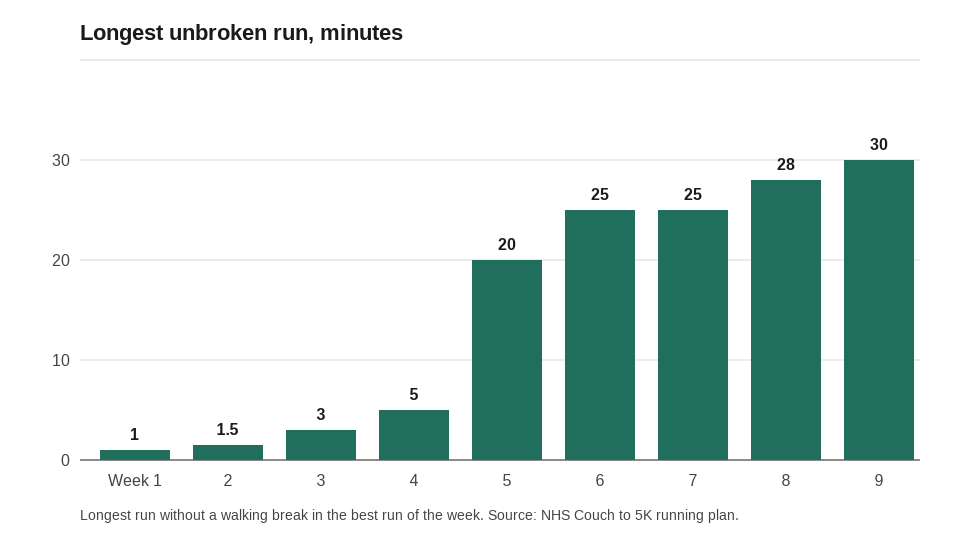
A worked week: in week 1 each session is 5 min warm-up, then 8 runs of 1 minute (8 min), 7 walks of 1 min 30 s (10 min 30 s), then 5 min cool-down. That adds up to 5 + 8 + 10.5 + 5 = 28 min 30 s, the NHS figure. In week 9 it is 5 + 30 + 5 = 40 minutes, three times, so 120 minutes on your feet in the week, 90 of them running.
When to repeat a week
The NHS gives no test, only the permission: repeat if you are not ready. The following is the site's own rule of thumb, not an NHS criterion. Repeat the week if you had to stop before the end of a run, if you finished the last interval only by slowing to a shuffle, or if something hurt rather than tired. Move on when you finish all three runs of a week and could have kept going a little.
Week 5 is the place to be careful, because run 3 drops the walking breaks altogether. Repeating week 4 first costs one week.
Three of the NHS tips help with that: breathe steadily, matching breaths to steps (for example in for 3 steps, out for 2); keep your head up, back straight and shoulders relaxed; and stop if something does not feel right.
How this compares with the WHO guidelines
The weekly amounts adults are asked to reach, set by the WHO 2020 guidelines (Bull and colleagues), are laid out in the gym days per week post; the plan covers only the aerobic side, so add strength work, for example the 3-day full-body plan or training at home without weights.
Timing your runs
Thirty minutes at 6:00 per km is 30 ÷ 6 = 5 km; at 7:00 per km it is 30 ÷ 7 = 4.3 km. The pace calculator turns any time and distance into min per km, and the stretching after a run post covers the cool-down.
For clothing, the NHS suggests comfortable clothes, supportive running shoes, and reflective clothing in low light.
Where the figures come from
Published by Cursa de duminică (Tanna Software S.R.L). About the site, Methodology and sources.